


Roblox Software Engineer Interview Guide — Coding Assessment, OA Prep & Full Process (2026)


Introduction
The software engineering job market is predicted to grow by 17% by 2033, and this growth is evident across industries, including the $455 billion-worth global gaming market. As Roblox targets a 10% market share, software engineers are at the center of operating this large user-generated gaming content platform at a massive scale. Engineers work on real-time distributed systems, advanced physics simulation, AI-driven safety, and 3D creation, making Roblox accelerate hiring across new grad, intern, and experienced levels. This growth is also reflected in rising searches about the Roblox coding assessment and the Roblox new grad interview process, signaling strong candidate demand and increased competition.
By outlining each stage of the Roblox software engineer interview, this guide will help you understand how Roblox evaluates technical depth, collaboration skills, and your ability to build reliable systems for billions of creators and players worldwide. You will also find structured questions examples, preparation strategies, and company-specific tips that reflect real interview patterns.
Roblox Software Engineer Interview Process
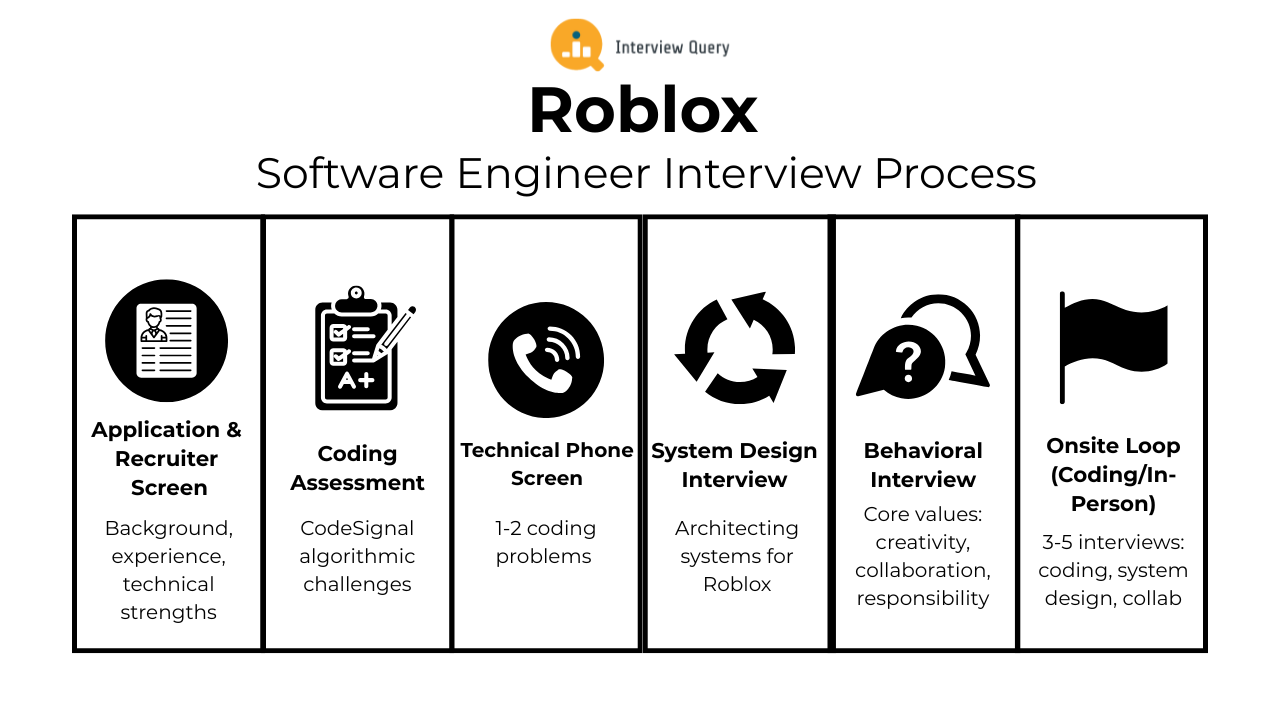
The Roblox software engineer interview process is structured yet fast-moving, and it remains fairly consistent whether you’re applying for an internship, a new-grad role, or an experienced engineering position. Candidates typically progress through an application review, an intro recruiter call, a coding assessment, a technical screening round, a system design interview, behavioral conversations, and a multi-round onsite loop.
Many candidates research Roblox coding assessment questions and the Roblox new grad interview process before applying, since these stages determine most forward progress.
Application and resume screen
Roblox recruiters prioritize applicants who demonstrate mastery of data structures, algorithms, distributed services, and strongly typed languages—most commonly C++, Luau, or systems-level languages. Experience with game engines, physics simulation, real-time rendering, or client–server architectures immediately stands out, especially for roles tied to the engine, simulation, or platform-stability teams.
If you’re early in your career, emphasize coursework, side projects, competition work, or internships that show systems thinking. Projects that required performance tuning, careful memory management, or asynchronous event handling signal that you understand the engineering challenges Roblox handles at scale.
How to strengthen your application:
- Highlight measurable impact (“reduced frame hitching by 18%,” “improved simulation throughput by 25%”), rather than listing tasks performed.
- Call out experience with concurrency, load testing, or large-scale behavioral simulations.
- Include links to Roblox games, plugins, or engine-level experiments you’ve built.
Tip: If you’ve built anything on Roblox, add a one-sentence summary of the engineering decisions behind it (data replication strategy, custom physics logic, network optimization, etc.).
Initial recruiter conversation
Your first call typically lasts 15–30 minutes and focuses on your background, areas of technical strength, and your familiarity with large-scale, user-generated content platforms. Recruiters may ask about:
- Interest in specific engineering groups (e.g., engine, physics, social features, moderation).
- Experience with performance-sensitive systems or latency-critical pipelines.
- Availability for the coding assessment and onsite loop.
Use this conversation to demonstrate curiosity about Roblox’s technical challenges: maintaining real-time consistency for concurrent players, improving safety features for a young audience, and building low-latency systems that scale globally.
Tip: Mention a specific Roblox technology or concept, like client–server replication, the Luau type checker, or deterministic simulation, to show genuine interest and platform awareness.
Roblox coding assessment
Roblox typically delivers its coding assessment through CodeSignal, where candidates complete two to three timed problems. These questions blend classic algorithmic challenges with simulation-style logic inspired by Roblox’s real-time update model.
Problems often involve:
- Array and graph traversal
- Queue/priority-queue–based event handling
- State updates across discrete ticks or frames
- Resource, event, or entity management with ordering constraints
Difficulty usually falls in the medium to medium-hard range. Many candidates are surprised to see problems that mimic lightweight concurrency, event loops, or real-time scheduling.
While algorithmic efficiency matters, Roblox places greater emphasis on correctness, defensive coding, and accurate state handling. Avoid clever shortcuts, as Roblox evaluates how reliably you handle edge cases and mutable state.
Tip: Spend extra time studying problems where state evolves over time (ticks, frames, or ordered events). Explore Interview Query’s full set of Roblox coding questions to demonstrate the careful reasoning interviewers look for.
Technical phone screen
The technical phone screen combines one or two coding problems with discussions about debugging strategies, memory or resource lifecycle, and platform-style client–server communication. Candidates should expect questions that mix algorithmic reasoning with practical systems engineering, such as:
- Safely tracking object lifetime across threads
- Avoiding memory leaks in real-time loops
- Validating and sanitizing state before sending it to clients
- Handling unpredictable network latency or inconsistent user input
Interviewers look for structured reasoning and clear verbal explanations. Walking through tradeoffs (time vs. space, safety vs. speed, determinism vs. flexibility) helps them evaluate how you work through real engineering decisions.
Tip: Try Interview Query’s data structures and algorithms learning path to sharpen your skills for data organization and manipulation. Then, practice explaining how you would test your code in a live environment with unpredictable latency, player behavior, or device variation.
System design interview
The system design round at Roblox differs from most big-tech interviews because it emphasizes real-time, distributed, and creator-driven ecosystems. Instead of generic microservices, you might architect systems such as:
- Real-time physics or state synchronization
- Scalable matchmaking services
- Creator asset ingestion pipelines
- Moderation or safety layers for user-generated content
- High-throughput event replication systems
Roblox evaluates whether you can design for deterministic behavior, latency sensitivity, fault tolerance, and fairness in multiplayer environments. You should be prepared to describe how your system behaves under sudden load spikes, ensures fairness or stability in player experiences, and is protected against malformed or malicious inputs.
Tip: Check out Interview Query’s real-world challenges to tackle product and business scenarios and test how well you can explain how your design maintains predictable, synchronized behavior under practical constraints.
Behavioral interview
Roblox’s behavioral interviews emphasize creativity, collaboration, and a strong sense of responsibility when building technology for a global audience that includes young users. Expect prompts about:
- Navigating ambiguity on fast-moving projects
- Advocating for safety or stability improvements
- Influencing teammates through clear communication
- Balancing engineering rigor with product needs
- Making design decisions that prevent user harm
Use specific examples with measurable outcomes. Describe not only what you did, but why you chose that approach and what impact it had on users or teammates.
Tip: Prepare a story that shows you proactively raised or resolved a safety, stability, or performance concern; Roblox values engineers who think ahead.
Onsite loop (virtual or in person)
The onsite loop typically includes three to five interviews spanning coding, system design, collaboration exercises, and values-based conversations. You’ll meet engineers, product partners, and occasionally people managers. Each round builds on the previous ones, giving the panel a holistic view of your communication skills, debugging style, and long-term engineering potential.
To excel:
- Ask clarifying questions before diving into solutions.
- Communicate assumptions and evaluate tradeoffs out loud.
- Keep the player and creator ecosystem in mind when weighing design choices.
Tip: When discussing tradeoffs, refer back to Roblox-specific challenges such as global concurrency, creator-driven input, or deterministic simulation. You can use our AI Interviewer to practice common industry questions and get tailored feedback in real-time.
After the onsite loop, Roblox consolidates feedback from all interviewers and sends it to a hiring committee, which evaluates your performance holistically. The committee looks for consistent strengths in problem solving, communication, engineering judgment, and alignment with Roblox’s values, especially safety, scalability, and creator empowerment. If the committee approves, you’ll move to the offer stage, where compensation, team placement, and start date are finalized.
To boost your confidence and sharpen your technical and communication skills for every stage of the Roblox engineering hiring process, book mock interviews with Interview Query.
Most Asked Roblox Software Engineer Interview Questions
Roblox software engineer interviews combine coding, systems thinking, debugging, and safety-driven decision making. Instead of evaluating only algorithmic speed, Roblox tests how well you build predictable, real-time systems, reason about multiplayer edge cases, and collaborate across a creator-first ecosystem. Candidates often search for Roblox coding assessment questions, Roblox system design examples, and behavioral interview guidance to prepare; the themes below reflect the patterns most frequently reported by successful applicants.
Read more: Twitch Software Engineer Interview Guide
Coding and algorithms interview questions
Coding questions appear in both the online assessment and the technical phone screen. Roblox favors problems that resemble simplified versions of platform challenges, such as real-time updates, entity management, and deterministic behavior. Expect questions involving graph traversal, state updates, dynamic entities, and careful handling of shared or evolving data. These questions often reward clean control flow, defensive handling of corner cases, and the ability to explain why your approach remains stable in a real-time environment.
Count the occurrences of creator-defined tags in a block of text, ignoring case.
The question evaluates string processing, hashing, and case-insensitive matching. A common strategy involves normalizing the paragraph to lowercase, then iterating through each tag group and counting matches using string search or tokenization. Implementations using dictionaries or frequency maps help keep the solution clean and scalable.
Tip: Tie your solution to moderation or safety workflows by explaining how efficient tag counting can help classify text before it’s surfaced to players or creators.
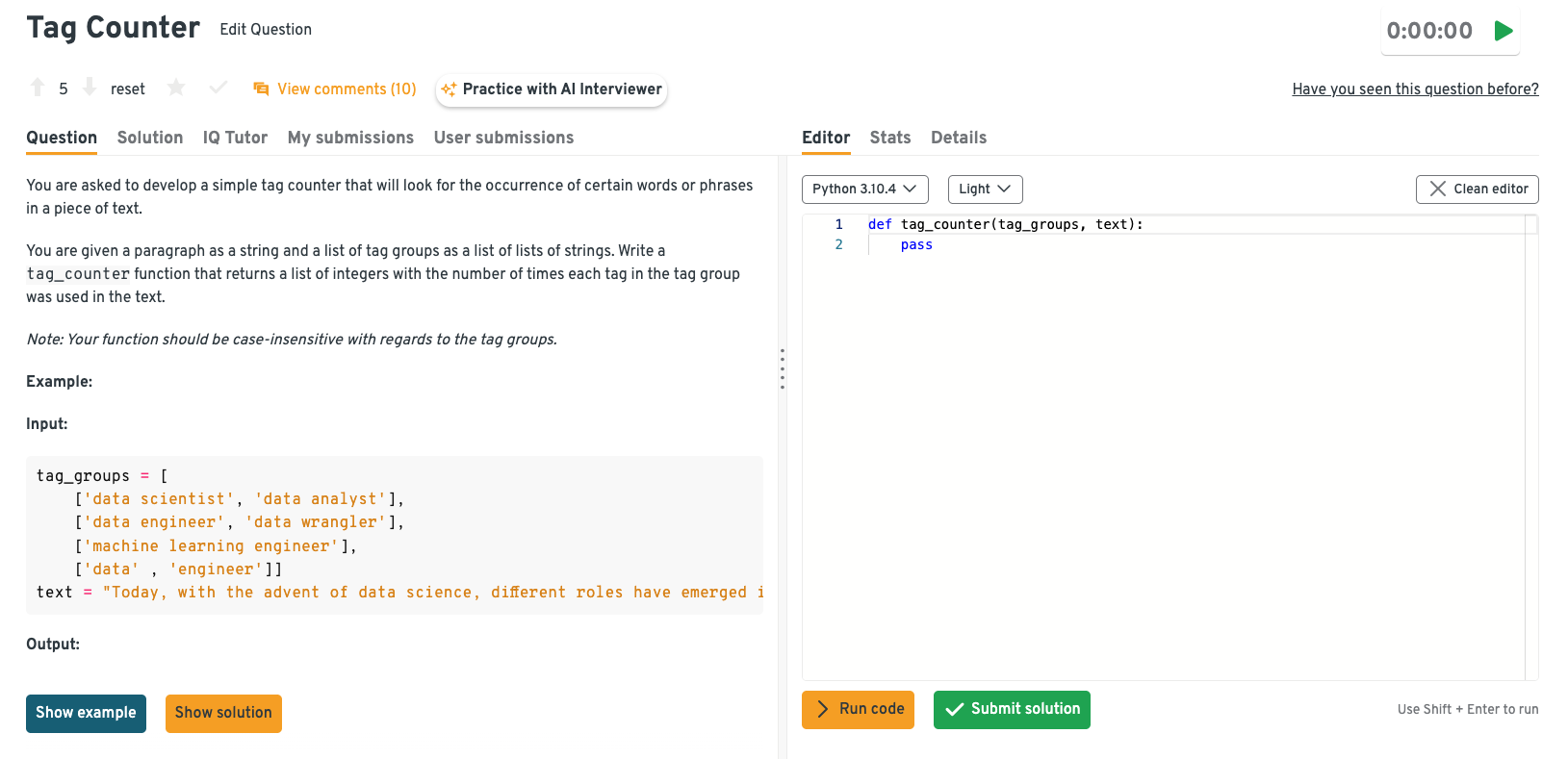
Keep building your coding skills by answering this and similar problems on the Interview Query dashboard. You can practice questions tailored for software engineering roles using the built-in editor and instantly compare your approach against detailed solutions.
-
This question involves dynamic programming, recursion, and combinatorics fundamentals. You can compute the number of paths by building a DP table where each cell equals the sum of the paths from the top and left, or by using the combinatorial formula based on binomial coefficients. Memoization is often used to avoid redundant recursive calls for larger grids.
Tip: Mention how grid-traversal logic mirrors pathfinding or navigation mesh reasoning in game environments, showing that you can connect algorithmic thinking to Roblox’s simulation challenges.
Design a rate-limited event scheduler.
You are being assessed on your ability to manage time-based constraints, queues, and controlled execution of events. The typical solution keeps timestamps in a queue or priority structure and ensures new events are processed only if they fall within the allowed rate window; otherwise, they’re delayed or discarded. Some candidates also introduce sliding-window counters or token-bucket logic to enforce deterministic throughput.
Tip: Connect your rate limiter design to high-throughput Roblox services, such as processing player actions or creator events without overwhelming backend systems.
Serialize and deserialize custom game entities.
It measures your grasp of data modeling, structured encoding, and reliable reconstruction of objects. The solution usually defines a clear schema for each entity, converts its fields into a string or byte representation, and then reverses the process to rebuild the object with full fidelity. Handling nested structures, versioning, and optional fields is a strong way to demonstrate robustness and real-world readiness.
Tip: Highlight how robust serialization helps maintain consistent entity state across Roblox’s client–server architecture, especially when dealing with replication or cross-platform gameplay.
Compute the updated median after inserting a new value into an ordered data stream.
This tests your understanding of incremental state updates, ordering, and efficient selection operations. You determine where the new element fits in the existing sorted stream, then compute the median based on the updated length: either the middle value (odd size) or the average of the two middle values (even size). For large streams, candidates often discuss using two heaps to maintain medians in near-constant time.
Tip: Relate your approach to how Roblox processes real-time data streams, for example by mentioning how median tracking could support live analytics or creator-facing monitoring tools.
Want a quick visual refresher? Watch this short walkthrough on maintaining medians in real-time data streams:
Together with Interview Query co-founder Jay Feng, Dan, a machine learning engineer, and data engineer, breaks down the coding question. He illustrates how two-heap structures efficiently track the median as new values arrive and shows why rebalancing the heaps is essential for keeping operations fast. As you prep for Roblox’s coding assessment and technical screen, consider Interview Query’s mock interviews, which can help your rehearse explaining your intuition and justifying design choices under pressure.
System design interview questions
Roblox’s system design interviews focus on the unique demands of a global user-generated platform. Instead of generic microservice patterns, you’ll architect systems that must operate deterministically, replicate state efficiently, and tolerate massive, sudden load spikes. Interviewers want to see clear reasoning around data flow, safety, scalability, and how your design behaves under stress, especially when creators or players push the system in unexpected ways.
Design a secure, scalable real-time messaging system for Roblox players.
A prompt like this evaluates your grasp of real-time communication systems, data consistency, and security fundamentals. A strong answer walks through using pub/sub messaging, sharded chat channels, and persistent storage for message history, while also addressing end-to-end encryption, rate limiting, and abuse prevention. It helps to mention multi-device sync via durable event streams and strategies for ensuring reliable delivery over unreliable client networks.
Tip: Bring in Roblox-specific constraints like chat moderation hooks or platform safety requirements, as doing so shows awareness of player-facing risks and platform expectations.
-
Here the focus is on search indexing, ranking algorithms, and serving systems optimized for millisecond-level latency. You might describe maintaining a prefix index or trie backed by a distributed search engine, with signals like popularity, personalization, or session context influencing the ranking. Caching hot prefixes and incrementally updating the index as experiences change demonstrate an understanding of scale and freshness.
Tip: Mention how Roblox’s massive catalog evolves quickly and how you’d keep the index fresh without heavy rebuilds.
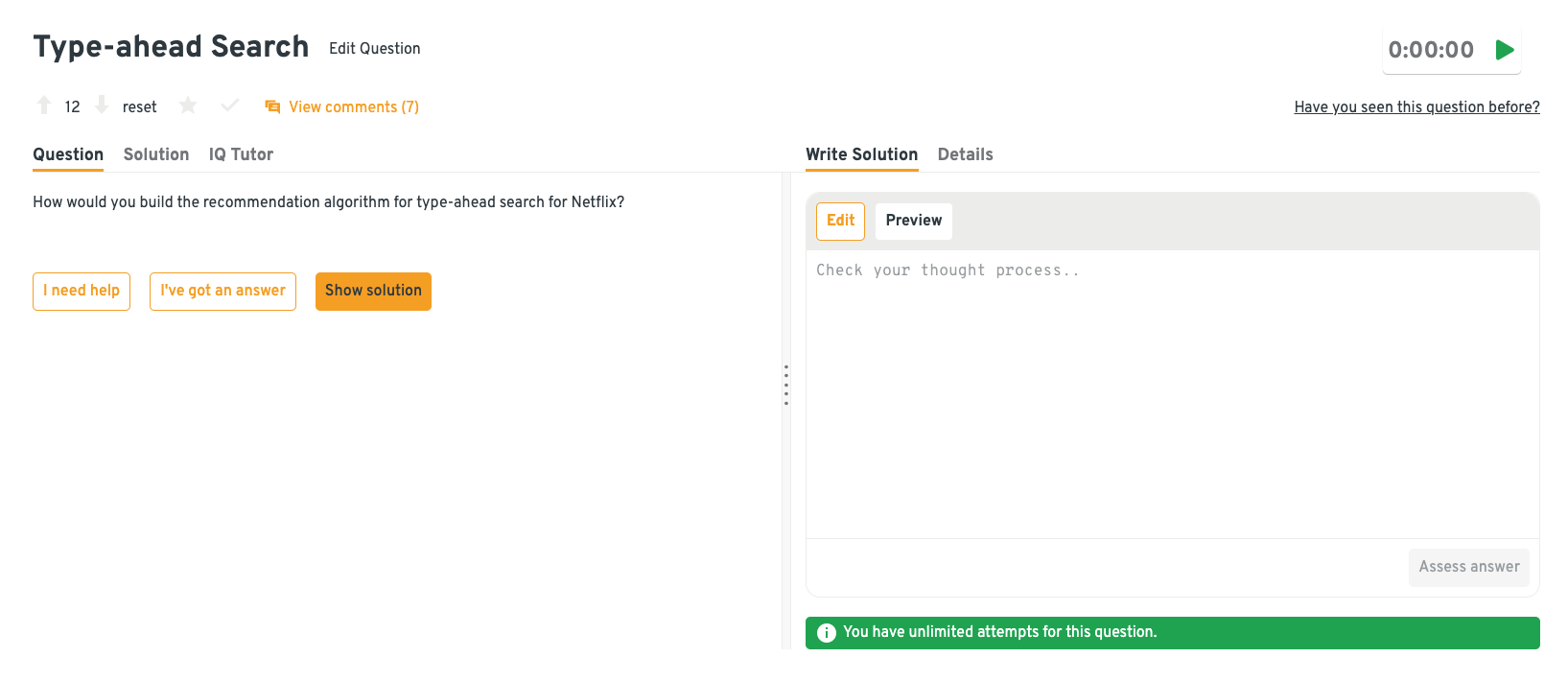
Visit the Interview Query dashboard to answer this system design challenge. You can also explore additional scenarios and get step-by-step guidance with IQ Tutor, which provides AI-powered tips to refine your design approach in line with Roblox’s engineering culture.
Build a large-scale CSV ingestion pipeline that processes creator analytics uploads.
Interviewers are looking for data engineering intuition, from ingesting large files safely to validating, transforming, and storing them efficiently. A good outline includes using asynchronous upload handlers, schema validation, and a distributed parsing stage that writes cleaned records into an analytics warehouse. Highlighting fault tolerance, metadata tracking, and how the processed data becomes query-ready for dashboards shows a complete end-to-end view.
Tip: Connect your design to how creators actually use analytics on Roblox, and note how you’d keep their dashboards responsive even as upload volume fluctuates across time zones.
Design a real-time physics synchronization service.
This tests your understanding of authoritative simulation, state replication, and minimizing latency in multiplayer environments. Start by describing running an authoritative physics engine on the server, broadcasting state deltas to clients, and using client-side prediction plus reconciliation to smooth out jitter. You can also mention interest management—sending only relevant objects to each player—to further reduce bandwidth.
Tip: Refer to real Roblox experience patterns, such as dense lobbies or physics-heavy gameplay, and explain how your sync strategy adapts to scenes with wildly different object counts.
Create a matchmaking service for millions of concurrent players.
The question probes skills in distributed systems, load balancing, and designing fair, scalable player allocation algorithms. Walk through maintaining real-time pools of players, grouping them by skill or preferences, and assigning them to available servers based on capacity and region. Incorporating queueing strategies, fallback logic when demand spikes, and telemetry for continuous tuning rounds out a solid approach.
Tip: It helps to talk about how Roblox’s global player base affects latency and fairness, especially when matching players across regions with uneven server availability.
Looking to sharpen your system design instincts even further? Check out Interview Query’s question bank, where you can explore a wide range of real-world scenarios that mirror the scale and complexity of Roblox engineering challenges. It’s a great way to practice thinking end-to-end, compare approaches, and build confidence before the interview.
Behavioral questions
Roblox behavioral interviews emphasize collaboration, long-term thinking, and responsible engineering. Because the platform serves a large youth audience, interviewers probe how you approach safety, communication, and ambiguous technical decisions. Expect prompts about influencing team direction under uncertainty, raising performance or user risks, balancing fast iteration with durable engineering, and working cross-functionally with product, data, or safety teams.
-
Roblox asks this to understand whether candidates genuinely connect with its vision of enabling millions of creators and building safe, scalable social experiences. It also helps interviewers gauge your motivation and how well you’ll fit into a highly collaborative, innovation-driven engineering environment.
Sample answer:
I’m excited about Roblox because its platform blends creativity, community, and cutting-edge engineering at an unmatched scale. I’m motivated by problems that require both strong technical thinking and an understanding of user safety, which aligns closely with Roblox’s priorities. My background working on distributed systems makes me eager to contribute to the platform’s growth. I also value engineering cultures that share context openly and iterate quickly, which is exactly how Roblox teams work.
-
Interviewers ask this to see how self-aware you are and whether you can grow in a fast-moving, team-oriented environment. Roblox values engineers who learn quickly, communicate clearly, and take ownership of their development.
Sample answer:
One strength I bring is breaking down ambiguous problems and communicating solutions clearly with teammates. I also tend to create tools or automation when I see recurring pain points, which has helped my previous teams move faster. A weakness I’m working on is saying “yes” to too many tasks, so I’ve been more intentional about scoping work and setting realistic expectations. That shift has improved my delivery speed without sacrificing quality.
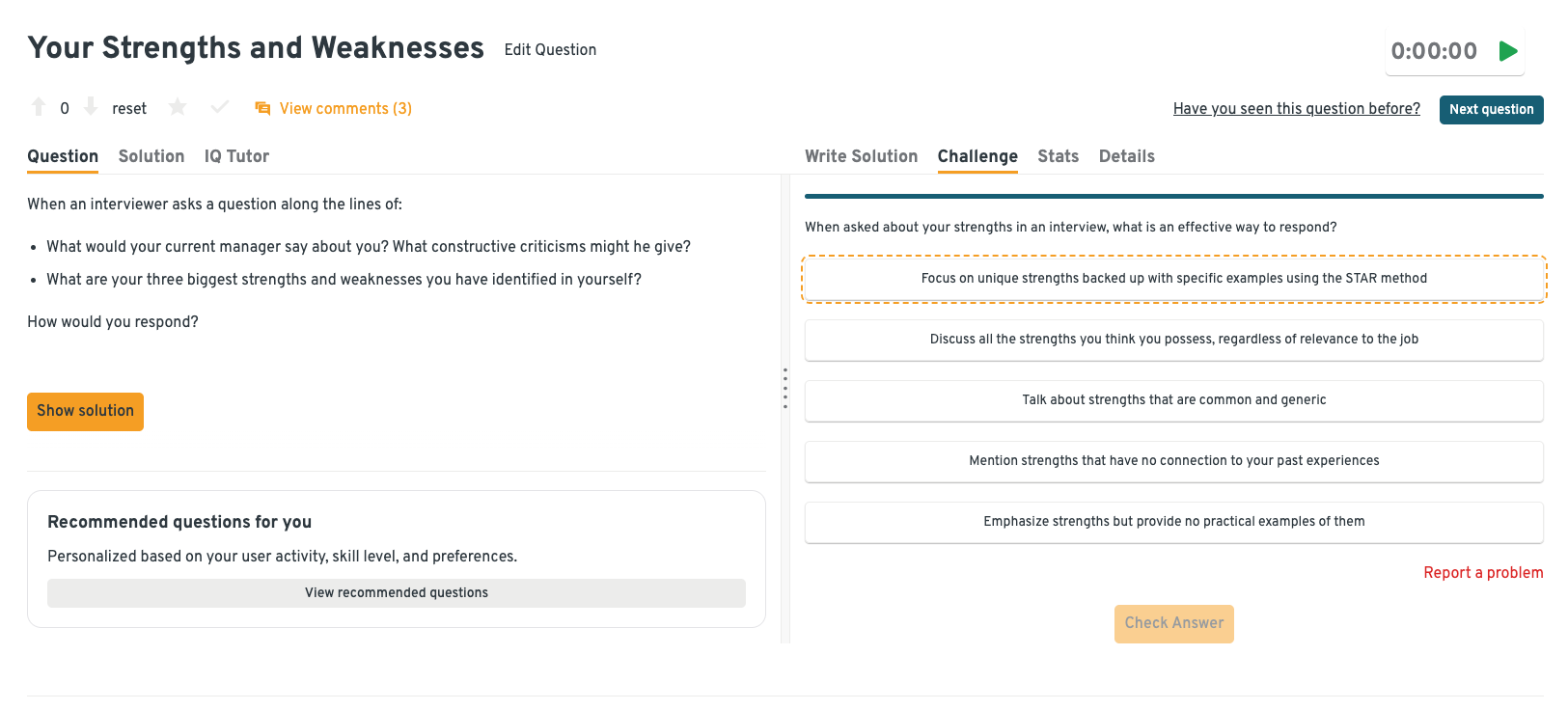
Check out the Interview Query dashboard to explore how to approach behavioral prompts like this one. See how other candidates responded in the comments, or try the challenge to check every aspect of your answer.
Tell me about a time you fixed a user-impacting issue under time pressure.
Roblox uses this question to understand your decision-making when outages or high-visibility bugs occur. The company wants to see calm problem-solving, clear communication, and a sense of responsibility.
Sample answer:
In a past role, a service I owned began timing out during peak traffic, impacting logged-in users. I quickly gathered logs, rolled back a risky config change, and communicated status updates to the on-call team. Once things stabilized, I added better alerts and guardrails to prevent similar issues. The experience taught me how much proactive monitoring matters during rapid growth.
Describe a conflict with another engineer and how you resolved it.
Roblox values collaborative engineers who can navigate disagreements constructively, especially given how cross-functional the work is. This question helps interviewers see how you handle differing opinions while keeping the project’s goals in focus.
Sample answer:
A teammate and I once disagreed on whether to optimize a system immediately or wait until after launch. Instead of debating endlessly, we walked through the data together and aligned on a hybrid plan: shipping first, then prioritizing optimization once we had real usage metrics. That compromise kept us on schedule and still addressed performance concerns. It also strengthened our working relationship moving forward.
Walk through a project where you balanced performance against creativity.
Roblox engineers frequently face decisions where user experience, creator flexibility, and platform performance must all coexist, so this prompt reveals how you think about trade-offs. Interviewers want to see thoughtful prioritization and user-centric reasoning.
Sample answer:
I once built a feature that allowed richer visual effects but risked increasing load times. After prototyping, I worked with designers to simplify some animations and added client-side caching to keep things fast. The final version preserved the creative feel without hurting performance. That experience reinforced how valuable it is to iterate with both technical and design constraints in mind.
As you prepare for the Roblox SWE interview, it helps to build confidence across every dimension. Write clean, efficient code, reason through large-scale system designs, and show strong communication and collaboration skills in behavioral conversations.
If you want to go even deeper, explore Interview Query’s Roblox software engineer questions, which organizes Roblox-relevant coding, system design, and behavioral topics so you can target exactly the skills you want to strengthen.
What Does a Roblox Software Engineer Do?
Roblox software engineers develop and maintain the foundational technology that powers one of the world’s largest immersive creation platforms. The work spans a broad set of real-time, performance-critical domains, from engine internals and advanced physics simulation to networking, safety systems, creator analytics, and the virtual economy for active developers.
Engineers primarily use Luau, C++, and internal tooling built around Roblox’s custom engine, all within a simulation environment where determinism, latency, and safety drive nearly every technical decision. Any feature you ship must gracefully handle traffic surges, unpredictable network conditions, and the constraints of shared, interactive 3D spaces.
Roblox engineering culture is deeply collaborative. On a typical day, engineers partner with product managers, technical artists, data scientists, machine learning specialists, and safety researchers to deliver end-to-end features that preserve user trust and platform consistency. A single milestone might require:
- Optimizing physics solvers or collision systems to improve frame stability
- Enhancing client–server replication logic for more predictable multiplayer behavior
- Refining in-experience notifications or UI flows used across devices
- Strengthening moderation, classification, or content integrity workflows
- Profiling performance and reducing memory or bandwidth usage on low-end hardware
Overall, working at Roblox means designing for scale and resilience while enabling creators to build safely, quickly, and expressively.
See Interview Query’s full Roblox interview guide to compare the engineering role across other teams and learn how it influences product direction through cross-functional partners.
How to Prepare for the Roblox Software Engineer Interview
Preparing for a Roblox software engineering interview means going beyond generic LeetCode practice. Roblox’s platform is built on real-time simulation, event-driven pipelines, and a massive client–server ecosystem, so interviewers expect you to show fluency not just in algorithms, but in reasoning about latency, ordering guarantees, and high-concurrency systems. Many candidates search for Roblox online assessment tips or how to pass the Roblox OA, but the strongest performers are the ones who understand why certain problems appear, and how they connect to Roblox’s architecture.
Roblox evaluates engineers on four core dimensions:
- Clarity of thought under time pressure
- Correctness and defensive coding practices
- Ability to reason in distributed, event-heavy environments
- Engineering judgment in real-time, high-scale systems
To build those skills systematically, follow this focused, highly actionable four-week plan.
Week 1: Algorithms + Implementation Accuracy
Your first week should reinforce fundamentals, but with precision and speed in mind—two things the Roblox OA rewards. Strengthen core data structures, traversal methods, dynamic programming, tree operations, and graph problems. Prioritize correctness, input validation, and clean reasoning. After solving a problem, rewrite your solution once with “frame-safe” logic (e.g., avoiding unnecessary recalculation each tick).
Tip: When answering coding challenges on Interview Query, use the timer to run 30–40 minute sessions and simulate Roblox’s OA pacing.
Week 2: Luau, simulation loops, and event reasoning
Roblox’s engineering culture expects familiarity with Luau, typed Luau, and the client–server execution model. Even experienced Lua developers underestimate how different real-time simulation feels when applied to a global platform. As such, build small scripts that update world state across ticks and practice reasoning through event ordering. This directly supports how to prepare for the Roblox OA, especially questions involving state updates, collisions, and entity lifecycles.
Tip: Review Roblox developer documentation for replication rules and RemoteEvent/RemoteFunction patterns.
Week 3: System design fundamentals
System design at Roblox focuses less on abstract architecture and more on scalability under continuous simulation. Candidates who can tie classical distributed systems ideas to Roblox-specific components like matchmaking, physics state propagation, or creator asset processing stand out immediately. Focus on reliability and predictable behavior rather than clever abstractions.
Tip: Evaluate failure scenarios: “If this microservice is 150 ms slower, what happens to the player experience?” This way, you start thinking the way Roblox engineers think: frame budgets, predictable latency, and designs that degrade gracefully under stress.
Week 4: UGC platform reasoning and mock interviews
Roblox’s creator ecosystem introduces unique engineering constraints, namely safety, content review, and runtime unpredictability. Research Roblox’s creator tooling, moderation pipeline, and real-time constraints. Then, practice explaining how you would design safe, scalable components that support millions of players through components like permission models, sandboxing, rate limits, and abuse prevention for creator tools.
Tip: Complete at least two mock interviews on Interview Query to sharpen your communication skills and receive peer feedback. Roblox interviewers value narrative clarity and thoughtful tradeoff reasoning.
By following this four-week plan, practicing event-driven reasoning, and designing with latency and safety in mind, you’ll build the exact instincts Roblox looks for across the OA, technical rounds, and final onsite interviews.
If you want personalized guidance, targeted feedback, or help refining your interview strategy, Interview Query’s 1:1 coaching sessions can accelerate your prep and give you a competitive edge. Experienced coaches can walk you through Roblox-style questions, evaluate your communication, and help you develop the systems intuition top candidates rely on.
Average Roblox Software Engineer Salary
Roblox software engineers earn some of the most competitive compensation packages in the gaming and real-time simulation space. According to aggregated data from Levels.fyi, total compensation tends to be strong across the board. This is not just because of solid base salaries, but due to equity packages that can grow significantly as Roblox continues to expand its platform and creator economy.
Roles span a wide range of technical depth: from entry-level engineers building core features to senior and staff-level developers architecting the systems that power millions of concurrent players. Compensation naturally scales with this scope. The compensation structure and career progression ultimately reward engineers who want to grow with the company and influence the future of the platform.
Compensation by level
| Level | Total / Year | Base / Year | Stock / Year | Bonus / Year |
|---|---|---|---|---|
| IC1 (Entry-level) | ~$215K | ~$154K | ~$53K | ~$10K |
| IC2 | ~$330K | ~$190K | ~$142K | ~$2K |
| IC3 (Senior) | ~$410K | ~$220K | ~$188K | ~$2K |
| IC4 | ~$490K | ~$270K | ~$213K | ~$4K |
| IC5 (Principal) | ~$765K | ~$320K | ~$420K | ~$7K |
Compensation rises significantly after year two as equity begins to vest more fully.
Average Base Salary
Average Total Compensation
Regional salary comparison
| Region | Salary Range | Notes |
|---|---|---|
| San Francisco Bay Area | ~$220,000 to ~$520,000 | Highest compensation due to proximity to Roblox HQ and cost of living |
| United States Remote | ~$180,000 to ~$420,000 | Range varies by state and remote-level classification |
| Europe (select roles) | ~$140,000 to ~$260,000 | Fewer engineering roles; compensation depends heavily on local market |
Engineers working on mission-critical areas, e.g., networking, physics, infrastructure, or trust & safety, may see higher offers that reflect the complexity and impact of these teams. Remote-friendly positions can introduce small variations based on location and market adjustments, but Roblox generally aims for pay parity to attract top-tier distributed talent.
Final Tip: Before negotiating your Roblox offer, compare it against salary data from multiple sources so you understand where your package sits relative to market norms, seniority expectations, and role scope.
If you want a clearer picture of what engineers at top tech companies actually earn, explore Interview Query’s salary guides. They compile verified compensation data across levels, roles, and locations, making it easier to spot trends, identify red flags, and walk into negotiations fully prepared.
FAQs
What is the Roblox assessment like?
The assessment blends algorithmic challenges with questions inspired by real simulation and event-driven logic. You will work through problems involving state updates, entities, and traversal methods. The structure is shorter and more focused than typical general coding platforms because Roblox evaluates clarity, correctness, and your ability to reason through game-like scenarios.
Is the Roblox OA proctored?
The Roblox online assessment is not typically live-proctored, but it does include system checks and monitoring features built into the testing environment. Candidates should treat the session as a secure exam and avoid any external resources or collaboration.
How long does the Roblox OA take?
Most candidates complete the assessment in 70 to 90 minutes. The session includes timed algorithmic questions and simulation-style logic problems, so pacing and quick reasoning matter.
Is Roblox OA automatic?
Yes. The Roblox OA is auto-graded based on correctness and edge-case handling. Submissions that fail fundamental cases or miss constraints often prevent candidates from advancing. High-quality, well-tested solutions help distinguish you from the broader pool.
What are Roblox new grad SWE levels?
Roblox commonly hires new grads into early engineering levels that emphasize mentorship, code quality, and long-term architectural thinking. Levels typically begin at E3, where engineers build foundational skills and gradually take on more ownership across engine, platform, and safety teams.
What is the Roblox SWE intern process?
The intern process mirrors the new grad flow but has slightly condensed interview rounds. After the recruiter conversation, interns usually complete the coding assessment, followed by a technical screen and a shorter onsite loop. Intern interviewers focus heavily on communication, curiosity, and your ability to learn quickly.
How hard is the Roblox coding assessment?
The difficulty is generally considered moderate. Most problems are similar to medium-level algorithmic challenges but require strong attention to state management and predictable logic. Candidates who prepare with structured Roblox OA tips and develop comfort with event ordering and simulation loops tend to perform the best.
Prepare for Your Roblox Software Engineering Journey with Interview Query
The Roblox software engineer interview rewards thoughtful preparation, consistent practice, and a solid grasp of how large-scale creator platforms function. When you understand the structure of the coding assessment, the systems-thinking mindset Roblox expects, and the communication patterns that set standout candidates apart, you can approach each stage with confidence.
The strongest performers consistently tie their problem-solving back to latency, concurrency, and safety, while reinforcing their communication skills through repeated dry runs and targeted feedback.
To keep building momentum, explore Interview Query’s question bank for technical, system design, and behavioral questions, learning paths to brush up on fundamentals, and mock interviews for peer practice and feedback. With the right preparation and the right support, you’ll walk into the Roblox SWE interview ready to perform at your peak.