


Docusign Product Manager Interview Guide: Process, Tips & Sample Questions (2026)


Introduction
Product management is growing rapidly, with industry reports showing a 10 to 14% compound annual growth rate as companies prioritize digital transformation and AI powered workflows. At Docusign, product managers play a central role in shaping how millions of users create, sign, and manage agreements, which makes the role both high impact and highly competitive. Fewer than 12 to 18% of applicants typically pass the initial screening because Docusign looks for candidates who can think across user experience, workflow design, analytics, and strategic decision making while operating in a domain where clarity and trust matter.
What makes the process challenging is not just the difficulty of the questions, but the breadth of skills evaluated. Candidates must reason through ambiguous product problems, justify trade offs, understand agreement workflows, and communicate decisions with precision. This guide breaks down each stage of the Docusign product manager interview, highlights common PM interview questions, and shares proven strategies to help you stand out and prepare effectively with Interview Query.
Docusign Product Manager Interview Process
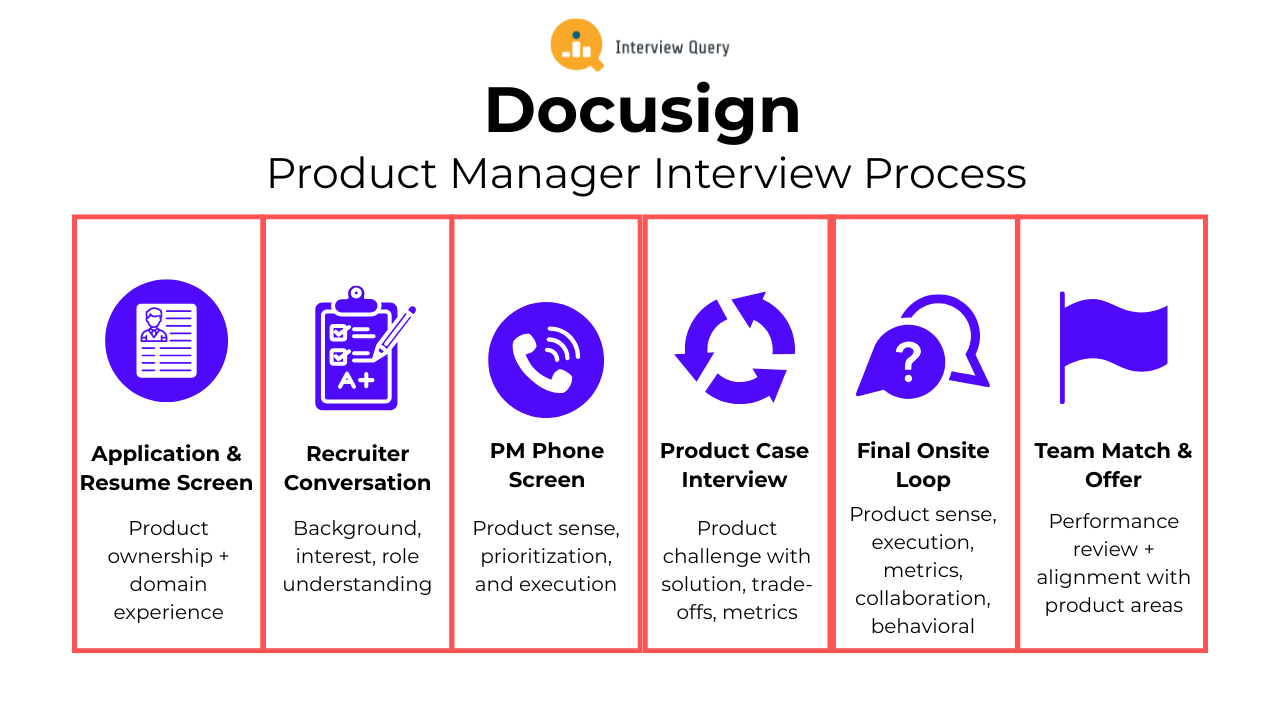
The Docusign product manager interview process evaluates how you think, communicate, and solve problems across the full product lifecycle. Interviewers look for candidates who can reason through customer needs, define clear requirements, collaborate with engineering, and measure the impact of features across eSignature, Contract Lifecycle Management, and workflow automation products. Most candidates complete the process within four to six weeks, depending on team schedules and role level. Below is a detailed breakdown of each stage and what Docusign assesses along the way.
Application and Resume Screen
Recruiters look for end to end product ownership, experience collaborating with engineering and design, and familiarity with workflow tools, enterprise software, or automation platforms. Strong candidates highlight measurable outcomes such as reduced friction in user flows, improved adoption metrics, or successful feature launches. Domain experience in digital agreements, compliance, security, or integrations can help differentiate your application.
Tip: Use clear metrics such as increased activation, reduced churn, or improved task completion to demonstrate impact and product intuition.
Initial Recruiter Conversation
The recruiter call focuses on your background, interest in Docusign, and understanding of product roles. Recruiters ensure your experience aligns with product discovery, prioritization, roadmap planning, and communication with cross functional teams. This stage also covers logistics, team placement, and compensation expectations.
Tip: Prepare a short narrative that connects your past product work to Docusign’s mission of simplifying and automating agreement workflows.
PM Phone Screen
This stage includes product sense, prioritization, and execution focused discussions. You may be asked to walk through how you would improve a feature, analyze a customer problem, or evaluate the success of a product change. Interviewers want to understand your ability to structure ambiguous problems, use customer insights effectively, and balance business value with engineering constraints.
Tip: Ground your answers in real examples. Clearly define the user, the problem, the constraints, and the measurable outcome you would aim for.
Product Case Interview
The case interview simulates a real product challenge. You may be asked to design an onboarding flow for new signers, reduce document turnaround time, or improve CLM usability for enterprise customers. The goal is to assess your ability to define the problem, explore solutions, outline trade offs, and propose meaningful metrics.
Tip: Start with clarifying questions, articulate your assumptions, and present a structured solution that ties directly to user needs and business value.
Final Onsite Loop
The onsite loop includes four to five comprehensive interviews that explore how you think across product strategy, execution, analytics, and collaboration within Docusign’s ecosystem. Each round mirrors real world scenarios you would face as a product manager.
Product sense and design round: You may evaluate a specific user journey, identify friction points, and propose improvements. Interviewers assess your creativity, prioritization, and understanding of agreement workflows.
Tip: Focus on the user’s goals, the pain points they encounter, and the simplest possible solutions with clear justification.
Execution and prioritization round: This round tests decision making under constraints. You may be asked to choose between competing roadmap items, balance technical debt with new features, or address unexpected declines in key metrics.
Tip: Use a structured framework to weigh impact, complexity, risk, and customer value.
Analytics and metrics round: You will interpret data, define success metrics, or reason through experiment results. Interviewers look for strong analytical thinking and an understanding of how agreements move through the funnel.
Tip: Tie metrics back to user behavior and actionable insights rather than listing formulas.
Cross functional collaboration round: This discussion centers on how you work with engineering, design, sales, and customer success. You may walk through past examples of resolving misalignment or navigating conflicting priorities.
Tip: Highlight proactive communication, expectation setting, and your approach to driving clarity.
Behavioral and culture fit round: Interviewers evaluate ownership, communication, and adaptability through scenarios related to ambiguity, stakeholder feedback, and product failures.
Tip: Use concise, structured stories that demonstrate accountability and thoughtful decision making.
Team Match and Offer
Once onsite feedback is compiled, hiring managers review your performance across all competencies and determine team alignment. You may discuss which product groups best match your skills, from eSignature and identity verification to CLM, templates, or workflow automation. Approved candidates then receive an offer that includes base salary, stock, and bonus components.
Tip: Share your preferred product areas early so recruiters can advocate for the teams that best fit your experience and long term goals.
Ready to elevate your Docusign product manager interview prep? Explore real product sense, execution, and strategy questions on the Interview Query Dashboard and start preparing with confidence today.
Docusign Product Manager Interview Questions
The Docusign product manager interview blends product sense, execution, analytics, and behavioral evaluation to understand how you make decisions in complex agreement workflows. Interviewers want to see structured thinking, strong user empathy, clear prioritization, and the ability to communicate trade offs across engineering, design, legal, and customer teams. These questions reflect real challenges across eSignature, Contract Lifecycle Management, AI assisted document intelligence, and integrations that power the Agreement Cloud.
Read more: Product Manager Interview Questions: A Comprehensive Guide
Product Sense Interview Questions
These questions assess how well you identify user problems, design intuitive solutions, and think creatively within Docusign’s ecosystem. Interviewers look for clarity of thought, strong problem framing, and awareness of how agreement workflows function from preparation through signing and completion.
How would you improve the signer experience for users completing agreements on mobile devices?
Docusign asks this to evaluate how well you understand mobile constraints in high trust signing flows. A strong approach begins by identifying friction points such as zooming, navigation, and field placement, then prioritizing solutions that reduce cognitive load. You might simplify scrolling patterns, increase tap target sizes, or introduce guided signing cues. The key is balancing usability with the secure, compliant nature of Docusign workflows.
Tip: Frame your recommendations around reducing confusion and accelerating completion without compromising accuracy or signer confidence.
How would you approach identifying and removing duplicate product listings in a large e-commerce catalog? Docusign uses questions like this to assess your general problem framing and ability to reduce complexity in structured data environments like CLM. Start by defining what constitutes a duplicate, segmenting data sources, applying detection rules or embeddings, and validating changes with stakeholders. Emphasize clean data as a foundation for reliable workflows and reporting.
Tip: Highlight the importance of accuracy since duplicate or inconsistent information erodes trust in enterprise grade systems.
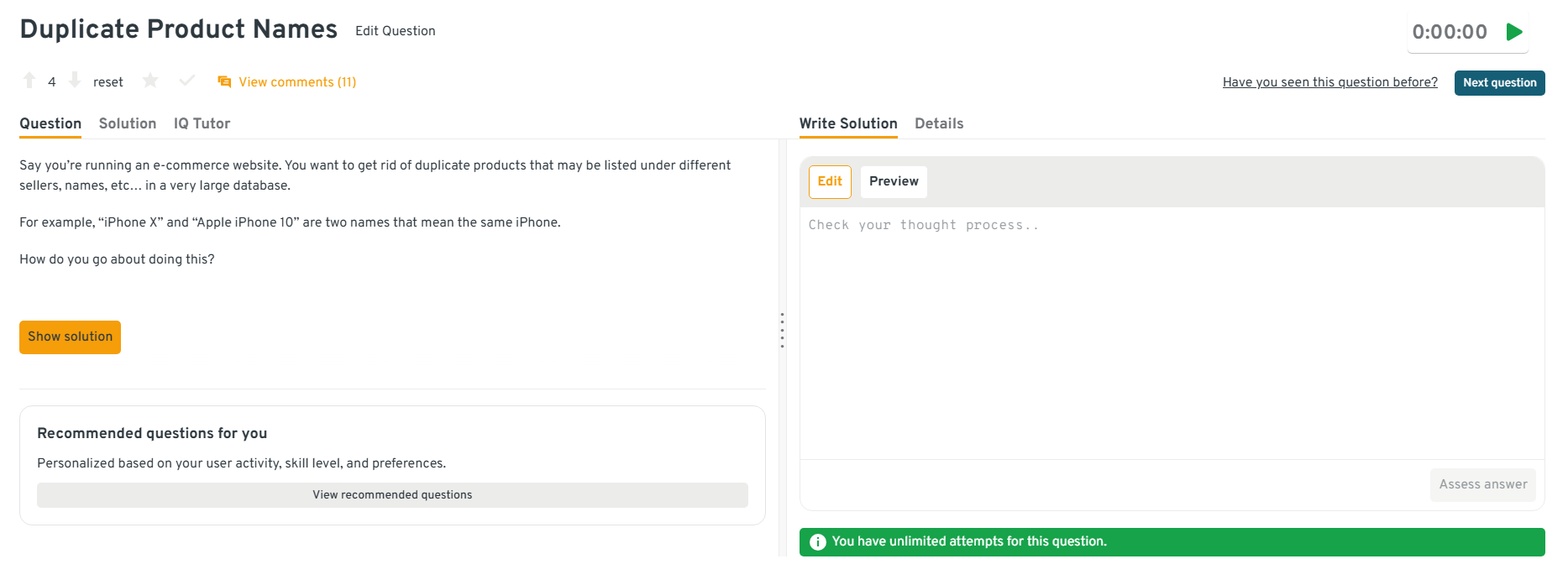
Head to the Interview Query dashboard to practice the full set of product manager interview questions. With built-in code testing, performance analytics, and AI-guided tips, it’s one of the best ways to sharpen your skills for Docusign interviews.
How would you investigate a 10% drop in usage on Google Docs?
Docusign uses this type of question to test your ability to analyze sudden shifts in user behavior across critical workflows. Begin by validating the metric, segmenting the drop by device, region, and workflow stage, and examining recent releases or UI changes. Explore whether friction increased, errors spiked, or a competing workflow diverted users. Present a structured investigation path that can be applied to drops in signer completion or CLM adoption.
Tip: Connect your analysis to funnel movements, since small friction points can cause large downstream effects.
-
Docusign asks cross domain questions like this to gauge your ability to evaluate experience quality beyond the agreement itself. Begin by mapping the end to end journey, identifying drop off points, and categorizing friction into navigation, content clarity, or action discoverability. Translate that approach to how a signer, sender, or legal reviewer interacts with Docusign flows. Propose experiments that validate which UI changes increase engagement or completion rates.
Tip: Emphasize measurable UX improvements such as reduced time to action or fewer unnecessary steps.
How would you design an AI powered document summarization tool for contract review?
This question probes whether you can design AI features that provide value without undermining trust or compliance. Describe starting with high value use cases like clause highlights or risk flags, ensuring transparency through source linking, and validating accuracy with legal teams. Explain how summaries should integrate naturally into CLM workflows and accelerate review rather than replace human judgment.
Tip: Stress that any AI feature in Docusign must enhance confidence, not introduce ambiguity or risk.
Watch Next: Meta Product Manager | Improving Search Feature | MAANG Interview Prep
In this mock product session, Zarrar, a senior data scientist, leads a structured walkthrough on how to improve Facebook’s search experience for users looking for activities in San Francisco, demonstrating how to break down open ended product problems with clarity. You’ll see how to pinpoint meaningful KPIs, interpret user intent, assess search quality, and recommend improvements supported by data. For anyone preparing for a product manager role, this exercise provides a clear, repeatable framework for defining metrics, prioritizing opportunities, and communicating decisions effectively.
Execution and Prioritization Interview Questions
Execution questions test your ability to break down complex initiatives, make trade offs, and keep product development grounded in customer value. You will often reason through constraints involving engineering effort, compliance requirements, or cross functional alignment.
A new update leads to a decline in agreement completion rates. How would you investigate the issue?
Docusign asks this to see whether you can triage workflow issues quickly in a high trust environment. Start by confirming the decline, segmenting by device, signer role, and workflow step. Review recent UI changes, error logs, and latency trends to identify whether the cause is technical, behavioral, or integration related. Prioritize the largest drop off points and partner with engineering to isolate root causes.
Tip: Tie your investigation to specific funnel steps like view, start, or sign to keep the analysis actionable.
How would you assess whether Google should build a new game feature for Google Home?
Docusign uses cross domain prompts to evaluate general execution ability. Define the user problem, size the opportunity, assess technical feasibility, and determine the minimum valuable experience. Translate that approach to evaluating new features in CLM or eSignature by focusing on customer value, adoption potential, and long term sustainability.
Tip: Emphasize prioritization frameworks since Docusign PMs frequently evaluate features competing for limited engineering cycles.
-
This question tests your ability to balance cost, scalability, and customer behavior. Compare each option’s impact on onboarding, friction reduction, and long term retention. Quantify expected adoption lift, consider operational costs, and align the choice with product maturity. Relate this to Docusign by showing how you would boost activation for a new workflow or CLM module.
Tip: Highlight data driven experiments to validate which investment delivers greater lift per dollar.
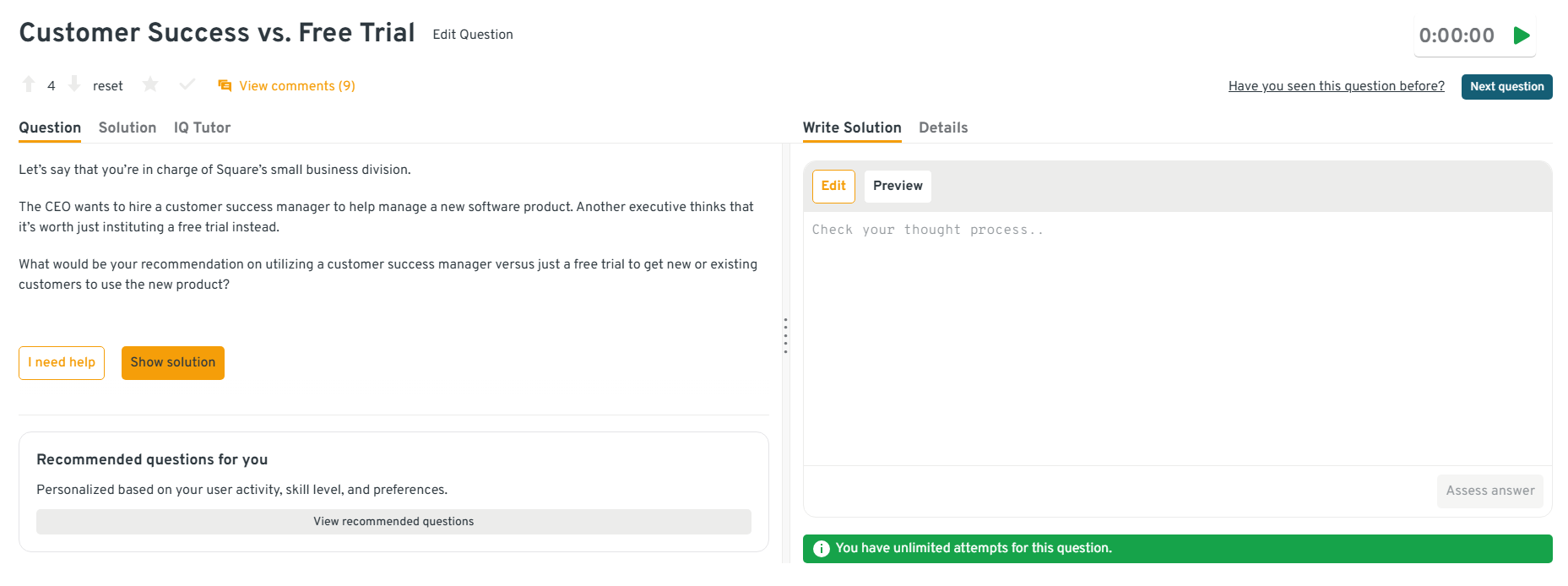
Head to the Interview Query dashboard to practice the full set of product manager interview questions. With built-in code testing, performance analytics, and AI-guided tips, it’s one of the best ways to sharpen your skills for Docusign interviews.
A cross functional partner pushes for a feature your team cannot realistically deliver this quarter. How do you respond?
Docusign uses this to assess collaboration and expectation management. A structured response includes clarifying the request, sharing capacity constraints, presenting data on effort and impact, and offering alternative paths. You should facilitate alignment rather than shutting the idea down, ensuring the partner feels heard while keeping the roadmap realistic.
Tip: Show how you maintain trust through transparency and consistent communication.
-
Docusign asks this to see whether you can evaluate cross channel behavior across signing experiences. Explain how you would define unique users, group them by platform activity, and analyze differences in engagement, completion, and time to sign. Use the insights to inform platform specific improvements or rollout strategies.
Tip: Connect findings to platform optimization, such as prioritizing features that improve mobile signing or web based document prep.
Want realistic practice with product sense, execution, and strategy questions? Try Interview Query’s AI Interviewer for tailored feedback that mirrors Docusign’s product manager interview expectations.
Analytics and Product Strategy Interview Questions
These questions focus on how you define metrics, interpret data, and connect insights to decisions. Docusign values product managers who evaluate features with measurable outcomes tied to agreement workflows.
What metrics would you track to measure the success of a new eSignature feature?
This question reveals whether you understand the signing funnel and can link user behavior to meaningful outcomes. Strong answers define primary metrics like completion rate, time to sign, and errors encountered, supported by secondary metrics such as feature adoption, abandonment points, and signer satisfaction. Always tie metrics to specific workflow stages to identify where the feature adds or removes friction.
Tip: Mention how you would A/B test the feature to ensure improvements hold across segments.
-
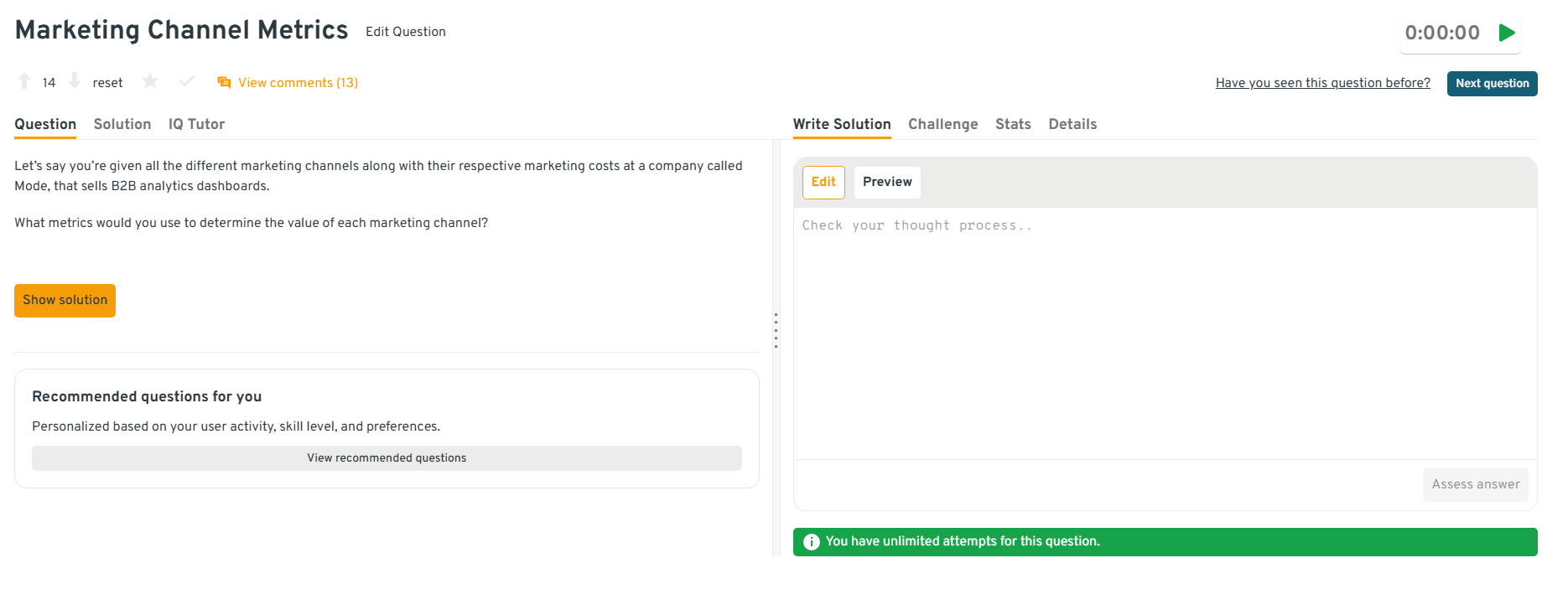
Docusign asks cross domain questions like this to see if you can assess channel performance using structured thinking. Start by defining the target action, comparing cost per acquisition, conversion rates, and retention across channels. Translate the learning to Docusign by explaining how similar evaluation informs feature adoption strategies for CLM or workflow automation.
Tip: Emphasize cohort based analysis to understand channel quality, not just volume.
Head to the Interview Query dashboard to practice the full set of product manager interview questions. With built-in code testing, performance analytics, and AI-guided tips, it’s one of the best ways to sharpen your skills for Docusign interviews.
What are the top five metrics that you would start tracking to understand the health of Google Docs?
The goal is to test whether you can define a concise metric set that captures product health. Identify metrics that reflect engagement, collaboration, and reliability, then relate that framework to Docusign by highlighting metrics like document views, completion rates, edit frequency, and time to sign. Show that you can pick metrics tied directly to user value.
Tip: Prioritize metrics that reveal both user intent and potential workflow friction.
-
This scenario tests your ability to interpret conflicting trends. Begin by confirming data accuracy, segmenting users, and isolating workflow changes such as new entry points or reduced email relevance. Explore whether in product navigation improved, making notifications less necessary. Connect this logic to Docusign scenarios where UI enhancements or automations might shift engagement patterns.
Tip: Suggest interviewing users to validate whether new behaviors are intentional or accidental.
How would you interpret a data trend showing increased edit rates before signing?
Docusign asks this to see how you connect behavioral signals to product decisions. Higher edit rates may indicate unclear fields, confusing templates, or changing contract needs. Form hypotheses by segment, map edits to workflow steps, and investigate whether the change impacts completion time or signer frustration. Propose experiments or template improvements to address the issue.
Tip: Pair quantitative analysis with user interviews to confirm why edits are happening.
Need 1:1 guidance on your product interview strategy? Explore Interview Query’s Coaching Program to work with mentors who can refine your approach and help you build confidence for your Docusign product manager interviews.
Behavioral Interview Questions
Behavioral questions evaluate how you navigate ambiguity, collaborate across teams, and demonstrate ownership. Docusign expects product managers to communicate clearly, build trust, and guide teams through complex decisions.
How comfortable are you presenting your insights?
Docusign asks this to determine whether you can communicate clearly across engineering, design, legal, and customer teams who depend on accurate, actionable insights. A strong answer explains how you structure information, adapt your style to different audiences, and use data to drive alignment. Emphasize clarity, confidence, and the ability to simplify complex workflows.
Example: “In a recent project, I presented a workflow analysis that clarified key friction points and secured agreement on a simplified design path that improved completion time by 12 percent.”
Tip: Highlight a moment where presenting insights meaningfully changed a product decision.
Describe a situation where a product launch did not go as planned. What did you do?
This question evaluates your ability to take ownership, respond calmly, and protect customer trust when issues arise. A strong answer details how you identified the problem, coordinated triage with engineering, and communicated proactively to stakeholders. Show that you implemented long term fixes to strengthen reliability, which is critical for Docusign’s high trust workflows.
Example: “A billing update caused unexpected user friction. I paused rollout, aligned engineering on fixes, and communicated clear timelines. The follow up launch achieved a 20 percent reduction in related support tickets.”
Tip: Tie your response to a measurable improvement that resulted from your actions.
What makes you a good fit for our company?
Docusign uses this question to assess alignment with its mission of simplifying secure agreement workflows. A strong answer connects your product mindset, experience improving complex processes, and ability to partner across engineering, legal, and design. Emphasize your interest in reducing friction, improving clarity, and supporting enterprise scale adoption.
Example: “In my last role, I redesigned a review workflow that reduced manual steps by 18 percent. Docusign’s focus on clarity and trust aligns directly with the type of impact I enjoy delivering.”
Tip: Reference Docusign values such as customer focus, trust, and operational excellence.
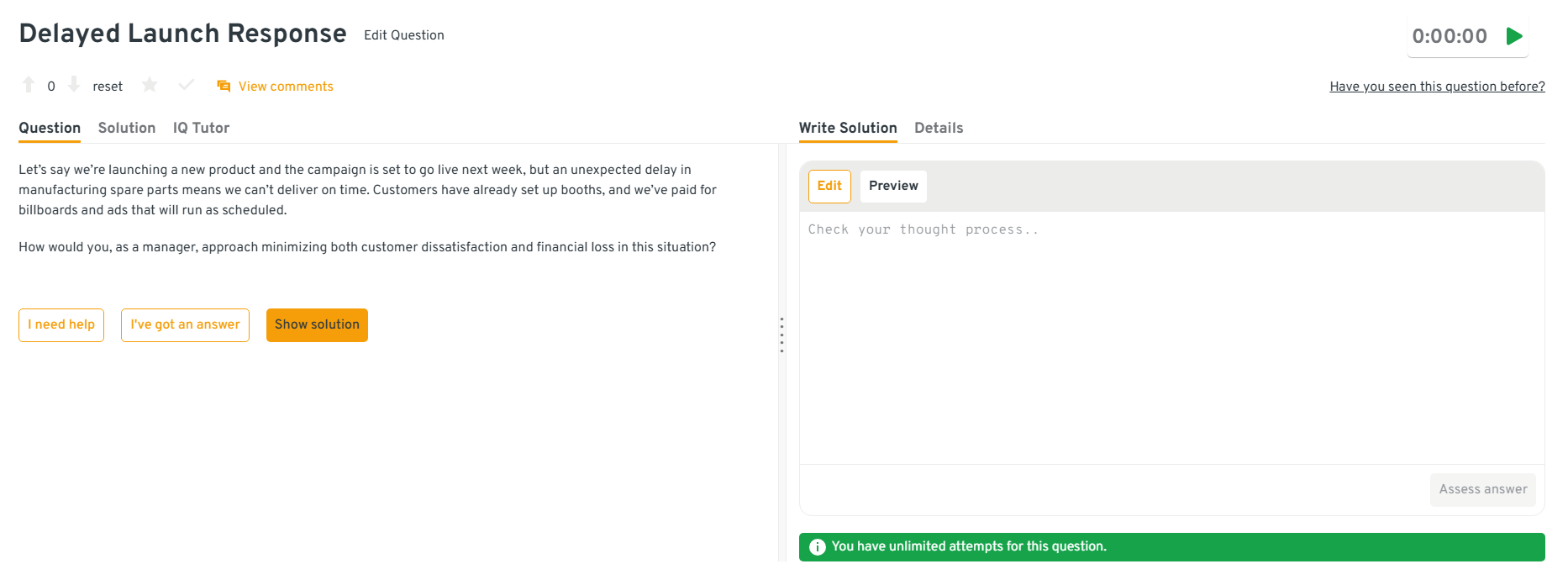
-
This question tests your judgment under pressure and your ability to maintain trust. A strong answer outlines how you reassess scope, align stakeholders, adjust messaging, and create mitigation plans that protect user experience. Docusign values PMs who balance realism with clear communication.
Example: “When a launch slipped due to integration issues, I partnered with marketing to pivot messaging and rolled out a staged release that preserved customer confidence.”
Tip: Show that you evaluate both short term risks and long term brand impact.
Head to the Interview Query dashboard to practice the full set of product manager interview questions. With built-in code testing, performance analytics, and AI-guided tips, it’s one of the best ways to sharpen your skills for Docusign interviews.
Tell me about a disagreement with an engineering partner and how you resolved it.
Docusign asks this to see whether you can bridge product goals and technical constraints. Your answer should highlight listening, reframing the discussion around user value, and collaborating to find a solution that honors both perspectives. Emphasize relationship building and shared ownership.
Example: “An engineer preferred a more complex solution. After aligning on the user problem, we agreed on a simpler approach that reduced delivery time by two sprints.”
Tip: Mention how the partnership strengthened afterward to show healthy collaboration.
Looking for hands-on problem-solving? Test your skills with real-world challenges from top companies. Ideal for sharpening your thinking before interviews and showcasing your problem solving ability.
What Does a Docusign Product Manager Do?
A Docusign product manager guides the strategy, roadmap, and execution of the tools that power the company’s digital agreement ecosystem. The role spans problem discovery, feature definition, customer research, and cross functional coordination across engineering, design, sales, and legal. Product managers ensure that every workflow in eSignature, CLM, and Agreement Cloud is intuitive, secure, and aligned with customer needs at enterprise scale.
Common responsibilities include:
- Defining product requirements for agreement workflows, including signer experiences, template management, routing logic, and audit capabilities.
- Driving new features across eSignature, CLM, and workflow automation, with an emphasis on usability, scalability, and trust.
- Partnering with engineering, design, security, and data teams to refine specifications and deliver high quality product iterations.
- Analyzing product adoption, funnel metrics, and customer feedback to identify opportunities, prioritize the roadmap, and measure impact.
- Working closely with enterprise customers to understand use cases, validate solutions, and support integrations with systems such as Salesforce, Workday, or ServiceNow.
How To Prepare For A Docusign Product Manager Interview
Preparing for the Docusign product manager interview requires a blend of strong product thinking, clarity around agreement workflows, and the ability to make structured decisions across technical, legal, and customer facing constraints. Because Docusign products support high trust, high volume transactions for organizations around the world, interviewers look for candidates who combine thoughtful prioritization with measurable impact and strong user empathy.
Below is a preparation roadmap tailored specifically to Docusign’s expectations.
Develop a deep understanding of agreement workflows: Study how documents move from creation to signing to storage across different customer segments. Pay attention to how friction, delays, or unclear interfaces influence the signing funnel.
Tip: Map out a typical end to end agreement journey and highlight three areas where improved product decisions could accelerate completion.
Build familiarity with enterprise software challenges: Learn how large organizations adopt tools like Contract Lifecycle Management, identity verification, and workflow automation. Consider the needs of legal teams, compliance requirements, and integrations with CRMs and HR systems.
Tip: Practice explaining how a feature would scale from a small team to a global enterprise.
Strengthen your ability to define clear problem statements: Docusign interviewers prioritize crisp articulation of user problems. Practice identifying root causes, validating assumptions, and narrowing scope before proposing solutions.
Tip: Use a simple template: user, goal, obstacle, and desired outcome.
Sharpen your metrics and experimentation skills: Be ready to define success metrics for features involving signing, viewing, and editing documents. Understand how to interpret funnel behavior and propose data driven improvements.
Tip: Create a small metric set for evaluating a feature you use daily and practice describing why each metric matters.
Improve your cross functional communication: Product managers work closely with engineering, design, security, legal, and customer success at Docusign. Practice communicating decisions using clear reasoning rather than jargon.
Tip: Rehearse how you would explain a roadmap change to both a technical and non technical audience.
Run product focused mock interviews: Focus on product sense, execution, and behavioral questions that simulate real agreement workflows. After each session, review whether your structure and prioritization were clear.
Use Interview Query’s mock interviews and PM question bank to practice realistic scenarios and get targeted feedback.
Tip: Record your responses and evaluate whether your answers deliver a clear narrative from problem to decision.
Want to strengthen your end to end product skills? Explore our Product Analytics 50 study plan to practice a curated set of product sense, execution, analytics, and strategy questions designed to help you excel across the full product lifecycle.
Salary And Compensation For Docusign Product Managers
Docusign product managers earn competitive compensation that reflects the company’s focus on secure digital agreements, enterprise workflow automation, and AI driven document intelligence. Salaries vary by level, team scope, and location, with total compensation packages typically combining a strong base salary, annual performance bonuses, and meaningful equity grants. Mid level and senior product managers make up a large portion of new hires, especially across eSignature, Contract Lifecycle Management, and Agreement Cloud platform teams.
Read more: Product Manager Salary
Tip: Align on your target level early in the process since salary bands, equity refreshers, and performance expectations differ significantly between PM, Senior PM, and Principal PM roles.
Docusign Product Manager Compensation Overview (2025)
| Level | Role Title | Total Compensation (USD) | Base Salary | Bonus | Equity (RSUs) | Signing / Relocation |
|---|---|---|---|---|---|---|
| PM1 | Associate Product Manager | $125K – $160K | $100K–$120K | Performance based | Standard RSU grants | Limited but possible |
| PM2 | Product Manager / Mid Level | $160K – $210K | $125K–$145K | Performance based | RSUs included | Offered selectively |
| Senior PM | Senior Product Manager | $205K – $260K | $145K–$170K | Above target possible | Larger RSU allocations | More common for senior hires |
| Principal PM | Principal or Lead Product Manager | $250K – $340K+ | $170K–$190K | Higher bonus multipliers | High value RSUs with refreshers | Frequently offered at this level |
Note: These estimates are based on 2025 salary data from Levels.fyi, Glassdoor, TeamBlind, and Interview Query’s compensation database.
Tip: Request location specific salary bands. Docusign compensation varies across Seattle, San Francisco, Chicago, and remote friendly markets.
Average Base Salary
Average Total Compensation
Negotiation Tips That Work For Docusign
Negotiating with Docusign is most effective when you anchor your expectations in data and demonstrate how your product decisions can influence customer adoption, workflow efficiency, or platform growth.
- Clarify your level and product area first: Compensation varies meaningfully between platform, AI, CLM, and signer experience teams. Understanding your target group helps calibrate expectations before formal discussions.
- Use credible market benchmarks during the negotiation: Pull data from Levels.fyi, Glassdoor, and the Interview Query salary database to frame your expectations with objective evidence.
- Highlight measurable product impact: Docusign values candidates who can demonstrate improvements in adoption, time to value, or workflow efficiency. Use concrete metrics when advocating for your compensation range.
- Consider remote versus on site differences: Equity and bonus ranges can vary by location. Request the full compensation breakdown for both remote and hybrid options if you are open to multiple setups.
Tip: Ask for clarity on vesting schedules, annual RSU refreshers, and bonus multipliers so you can evaluate your long term compensation alongside your initial offer.
FAQs
How long does the Docusign product manager interview process take?
Most candidates finish the interview process within four to six weeks. Timelines vary by team, role level, and scheduling availability, but recruiters typically provide updates after each stage to maintain clarity.
Does Docusign require digital agreements or CLM experience for product manager roles?
Not always. Domain experience is helpful, but the company primarily values strong product fundamentals, structured problem solving, and the ability to learn complex workflows quickly.
How technical is the Docusign product manager interview?
You will not be asked to code, but you should understand how APIs, platform constraints, and workflow dependencies influence product decisions. The focus is on communication, trade offs, and user centric reasoning.
Why should I consider a product manager role at Docusign?
Docusign PMs shape products that simplify agreements for millions of users worldwide. The role offers meaningful impact, broad collaboration, and opportunities to influence AI driven workflows and enterprise scale automation.
What skills does Docusign look for in product manager candidates?
Docusign emphasizes structured thinking, strong execution, clear communication, and a strong sense of customer empathy. Experience making data informed decisions and navigating cross functional environments is especially valuable.
Do Docusign product managers work closely with engineering and design?
Yes. PMs collaborate daily with engineering, design, legal, and customer facing teams to refine requirements, prioritize decisions, and deliver features that improve reliability, usability, and workflow efficiency.
What products should I be familiar with before interviewing at Docusign?
You should understand the core eSignature experience, Contract Lifecycle Management, workflow automation capabilities, and Docusign’s broader Agreement Cloud. Familiarity with AI assisted document intelligence is beneficial as the company expands in this area.
Does Docusign support remote and hybrid work for product managers?
Many product roles offer remote flexibility depending on the team. Some groups operate in hybrid setups, especially those collaborating closely across product, engineering, and design hubs.
How can I stand out during the Docusign interview?
Strong candidates show clear reasoning, demonstrate measurable product impact, and connect their experience to agreement workflows. Bringing structured frameworks and user centered thinking to each question helps differentiate your approach.
Become a Docusign Product Manager with Interview Query
Preparing for the Docusign product manager interview means strengthening your product instincts, sharpening your execution skills, and practicing clear, structured communication across real agreement workflow scenarios. To build confidence, explore the full Interview Query question bank and study how top candidates reason through prioritization, metrics, and product design.
You can also practice full interview simulations through our mock interview sessions, or get tailored guidance and feedback with Interview Query’s coaching program. By reviewing realistic product cases, refining your approach to user problems, and developing a consistent structure for every question, you will be prepared to stand out across all stages of the Docusign product manager interview.